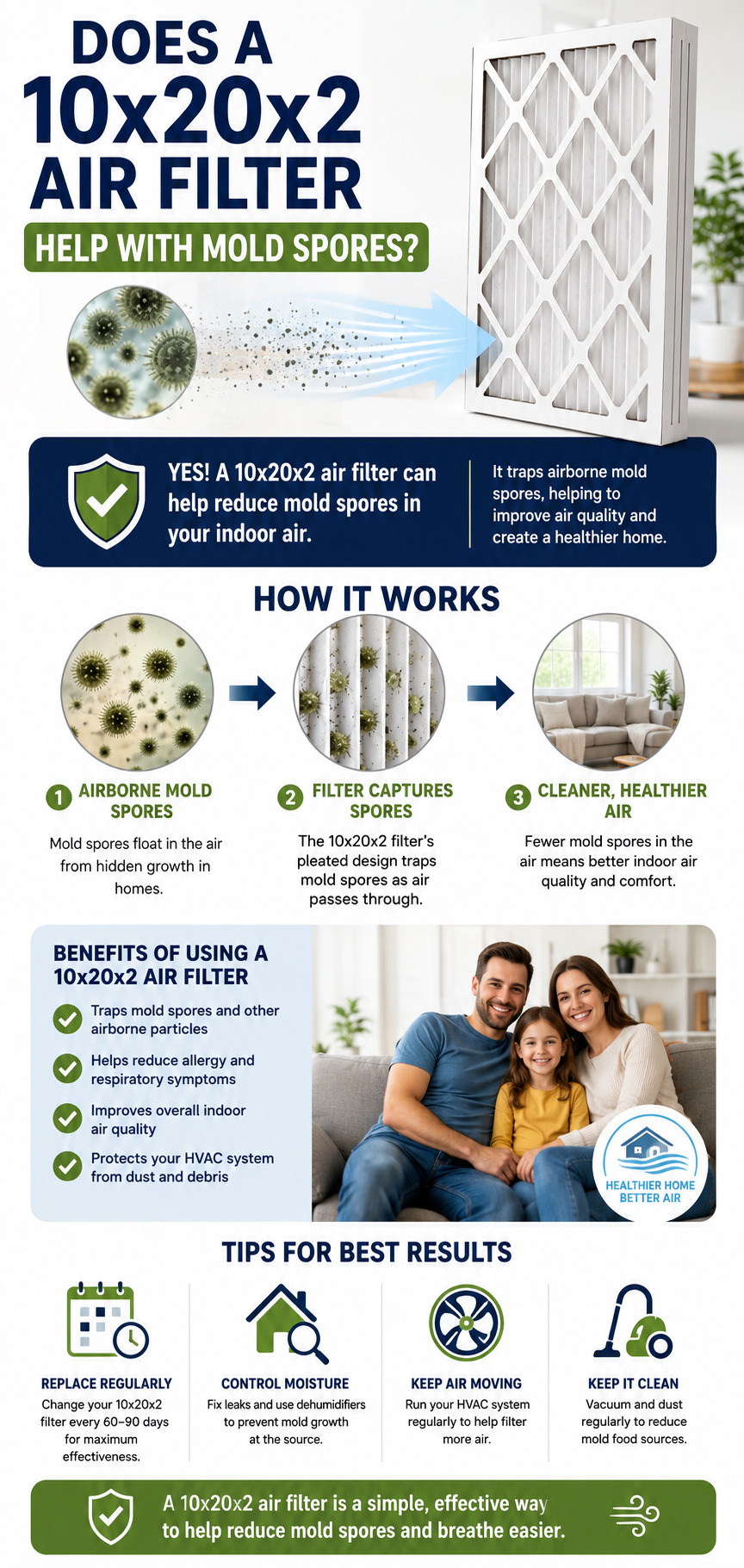
A 10x20x2 air filter does help with mold spores, and in a place as humid as West Palm Beach, that matters more than most homeowners realize. Mold copies itself by floating microscopic spores through the same air your AC pushes around every room. The right filter grabs a good chunk of those spores before they ever reach your nose. Two things have to be true for it to work, though. The filter needs a high enough MERV rating, and the air in your home has to stay dry.
TL;DR Quick Answers
10x20x2 Air Filters
A 10x20x2 air filter is a 2-inch-thick pleated filter, nominally 10 by 20 inches, that fits in your HVAC return and traps the dust, pollen, pet dander, and mold spores you can't see before they recirculate through your home. That extra 2-inch depth is the whole advantage over thin 1-inch panels:
• It holds more pleated surface, so it can run a higher MERV rating (we point most homes to MERV 11 to 13) without choking your airflow.
• It lasts longer between changes, usually up to 90 days, or every 30 to 60 in humid climates or homes with pets and allergies.
• When you replace it, match the size printed on the frame and point the airflow arrow toward the blower.
Top Takeaways
• A 10x20x2 air filter catches airborne mold spores when it’s rated MERV 11 to 13 or higher.
• The 2-inch depth lets a 10x20x2 pleated filter run a higher MERV without choking airflow, and it lasts longer between changes.
• A filter traps spores but won’t kill mold. Holding humidity at 30 to 50 percent is what stops it from growing.
• In our South Florida humidity, change the filter every 30 to 60 days, and more often in peak summer or allergy season.
• Filter plus dry air is the combination that actually protects your family and your system
How a 10x20x2 Air Filter Handles Mold Spores
Here’s what’s actually floating around your house. Mold spores run from a couple of microns up to about 30, small enough to stay airborne and ride your ductwork from room to room. An air filter pushes that air through a tight web of fibers and catches particles on the way through. The tighter that weave, the smaller the particle it can hold onto.
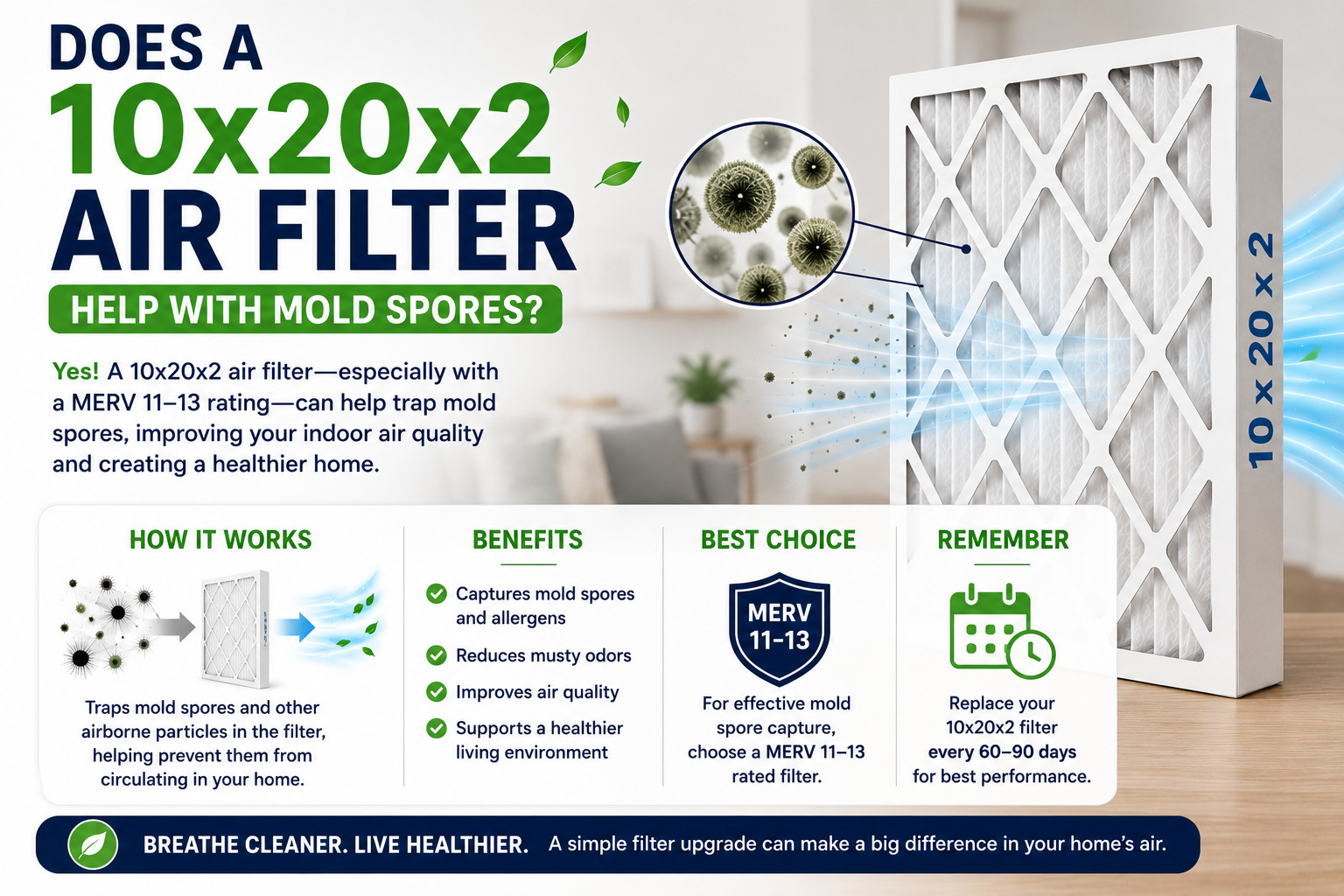
That tightness shows up as the filter’s MERV rating, which runs from 1 to 16 for home systems. A basic MERV 8 catches the bigger spores and clumps. Move up to MERV 11 through 13 and you start trapping the fine, single spores in the 1-to-3-micron range, the ones most likely to get into your nose and lungs. For a home where someone’s worried about mold, MERV 11 to 13 is the range we point people to.
This is where the 10x20x2 size pulls its weight. That 2-inch depth packs in far more pleated surface than a thin 1-inch panel, so the filter can reach a higher MERV without strangling your airflow, and it lasts longer between changes. A quality 10x20x2 pleated air filter gives you stronger spore capture and an easier job for your blower. Whether you shop it as an air conditioner filter 10x20x2 or a 10x20x2 pleated air filter, that 2-inch build is the upgrade doing the heavy lifting.
Now the part a lot of filter ads skip, and we’d rather give it to you straight. A filter catches spores that are already in the air. It can’t kill mold or stop it from growing. The EPA says it plainly: the key to mold control is moisture control. Keep your indoor humidity between 30 and 50 percent, fix leaks fast, and keep that AC drain line clear. Dry air plus a good filter is a real defense. One without the other just chases the same musty smell around all summer.
One more thing about our climate. Your system runs hard down here, and your filter clogs faster than the box promises. Swap your 10x20 air filter every 30 to 60 days, and sooner during peak summer or if anyone in the house fights allergies. A fresh air filter 10x20x2 keeps the airflow strong and keeps spores moving into the filter instead of back into your living room.
“After more than a decade of making filters and helping millions of homeowners, here’s what we’ve learned: a pleated MERV 13 only drops the spore load in a West Palm Beach home when the family also pulls their humidity under 50 percent. Handle the air and the moisture together, and you stop fighting that same musty summer smell year after year.”
7 Essential Sources Worth Bookmarking Before You Fight Mold
Every one of these comes from a government agency, a hospital, or a recognized health group, so you’re getting straight facts instead of a sales pitch.
• The EPA’s Homeowner Playbook for Mold and Moisture covers how to find, clean, and prevent household mold, straight from the agency that set the standard.
• The CDC’s Plain-Language Guide to Mold and Your Health explains what exposure does to your body and how to keep humidity in check.
• How Air Filters Actually Catch Particles walks through filter types, MERV ratings, and the way fibers trap spores.
• The U.S. Department of Energy’s Filter and AC Maintenance Checklist gives the official word on how often to change filters and protect airflow.
• The American Lung Association on Mold, Dampness, and Breathing shows why dampness alone, even without visible mold, can set off symptoms.
• Mayo Clinic’s Mold Allergy Guide helps you tell a mold allergy from a cold and spells out what actually helps.
• ENERGY STAR’s Guide to Filters and Efficiency ties cleaner air to a lower cooling bill from the same simple habit.
3 Statistics That Show Why Your Filter Earns Its Keep
• We breathe indoor air about 90% of the time. The EPA reports that Americans spend roughly 90 percent of their time indoors, where some pollutants run two to five times higher than outside. What your filter catches adds up fast.
• Close to half of U.S. homes battle hidden dampness. Research published through the NIH puts it near 47 percent of homes with dampness or mold problems, the exact setup that feeds spores into your air.
• Tens of millions react to spores every season. The Asthma and Allergy Foundation of America counts about 81 million Americans diagnosed with seasonal allergic rhinitis in a recent year, with mold spores among the most common triggers.
Our Honest Take: The Filter Is Step One, Not the Whole Fix
If you landed here hoping a filter by itself would wipe out a mold problem, we won’t sell you that story. A good 10x20x2 pleated filter at MERV 11 to 13 does real work. It pulls airborne spores out of the mix, eases allergy flare-ups, and protects the guts of your HVAC system. Across the humid homes we’ve serviced around Palm Beach County, that one upgrade changes how the air feels and smells.
The folks who actually beat mold are the ones who pair that filter with dry air. Get humidity under 50 percent, fix the leaks, keep the drain line flowing, and let the filter handle whatever’s left. Steer clear of anything promising a “mold-proof” home from a product alone, because that’s not how mold works. Filter plus moisture control is what we’d run in our own houses, and it’s what we’d tell a neighbor to do.
Frequently Asked Questions
Does a 10x20x2 air filter remove mold from the air?
It removes the airborne spores it can physically catch, and a MERV 11 to 13 filter grabs a large share of them. It won’t touch mold already growing on a wall, though. That takes cleanup and drier air.
What’s the best 10x20x2 allergen air filter for mold and allergies?
For a 10x20x2 air filter for allergies, go pleated and look for MERV 11 to 13. That range balances strong spore-and-allergen capture with the airflow your system needs. When people ask us for the best 10x20x2 air filter or the best 10 x 20 x 2 air filter for a sensitive household, a pleated MERV 13 is usually where we start.
Where can I find a 10x20x2 air filter near me?
It’s a common size, so a 10x20x2 air filter near me search usually surfaces local hardware and home-improvement stores. Can’t track down a 10x20x2 air filter nearby in the MERV rating you want? Ordering online lets you lock in the exact pleated, allergen-grade filter and set up auto-delivery so you never run short.
Is a pleated 10x20x2 better than fiberglass for spores?
For spores, yes. Those cheap fiberglass panels around MERV 1 to 4 exist to protect the equipment, not your lungs, and most spores sail right through them. A pleated 10x20x2 air filter catches far more of the fine stuff that matters.
Now Put That Filter to Work Against Mold Spores
If a 10x20x2 air filter helps with mold spores, the next move is simple: drop in a quality 10x20x2 pleated air filter rated MERV 11 to 13 and pair it with humidity under 50 percent. Do both, and you give those spores far fewer places to land before your next breath.
Learn more about HVAC Care from one of our HVAC solutions branches…
Filterbuy HVAC Solutions - Weston FL
2573 Mayfair Lane Weston FL 33327
(754) 296-3528
https://maps.app.goo.gl/E3tjmKf5VSWYghGc7